
PFAS Remediation
Introduction
PFAS “forever chemicals” are now detected in wastewater treatment plants (WWTPs) nationwide. Conventional treatment processes are not designed to remove these compounds, and the filtration technologies offered to address them, granular activated carbon (GAC), ion exchange, or reverse osmosis, typically cost tens to hundreds of millions of dollars per facility, a burden ultimately passed on to ratepayers.
There’s now a practical alternative. Boylan Crest Advisors and Bio-Chem offer a different approach: a patented mineral treatment system that has demonstrated over 90% average PFAS remediation from the water in on-site trials, requires no filtration, no capital construction, no permit modification, and can be deployed at scale, and is priced to be close to cost-neutral against the chemical treatment plants already budget for today. A 60-day field trial lets any wastewater treatment plant (WWTP) evaluate the results firsthand.
Trial commitment
60 days
No long-term contract · no infrastructure changes · close to cost-neutral vs. current chemical spend
The PFAS Challenge Facing Water Utilities
PFAS contamination is no longer an isolated issue: as states roll out their own monitoring programs, the same pattern keeps appearing; PFAS is detected in nearly every wastewater treatment plant tested, conventional biological treatment does little to remove it, and the filtration technologies capable of removing it are prohibitively expensive at scale.
Maine’s 2022 DEP PFAS TESTING AND Monitoring Program at WASTEWATER TREATMENT PLANTS
The program was designed to identify PFAS concentrations entering Maine’s waters, establish baseline effluent levels, and inform future discharge regulations and source-water protection programs. The resulting database which contains thousands of analytical results across 28 PFAS compounds is among the largest coordinated PFAS wastewater datasets assembled by any state agency.
Key Findings
1. PFAS is detected throughout Maine
PFAS compounds are present in wastewater discharges across virtually all sectors and geographic regions of the state. DEP’s central finding is that WWTPs are generally receivers, not generators, of PFAS: the contamination enters municipal systems through residential wastewater, industrial discharges, commercial laundries, landfill leachate, consumer products, and firefighting foam; not from the treatment plant itself.
2. Conventional treatment removes very little PFAS
This reinforces a national pattern: biological treatment effectively removes BOD, TSS, and nutrients, but PFAS largely passes through and remains detectable in final effluent, biosolids, and landfill leachate. Treated effluent is consequently a measurable PFAS pathway to Maine’s surface waters.
3. Implications for WWTP, governing Authorities and Utilities
- PFAS contamination is widespread and persistent.
- Municipal utilities often serve as collection points for PFAS originating elsewhere in the watershed.
- Future discharge permits are likely to include PFAS monitoring and limits.
- Biosolids management and landfill disposal options are becoming more constrained.
Maine’s LD 1911 investigation covered 124 municipal and industrial facilities monitored, 28 PFAS compounds analyzed, effluent and groundwater both sampled and gives the state a scientific baseline for future PFAS regulation and wastewater management. The data are consistent with the national picture: PFAS contamination is widespread, conventional treatment provides little destruction, and source control and treatment innovation will be central to regulatory compliance going forward. Utilities in other states are likely to find similar results as their own monitoring programs expand.
Wastewater Effluent Monitoring for PFAS Report (Maine DEP, November 2023)
Cost of conventional removal at scale
$14–$28 billion
Minnesota’s estimated cost to remove PFAS from municipal wastewater statewide using conventional methods, over 20 years (MPCA PFAS Blueprint, Barr Engineering / Hazen and Sawyer, 2023)
Our Solution: Bio-Chem’s Patented Treatment System
Boylan Crest Advisors has partnered with Bio-Chem to bring its patented treatment compositions to wastewater treatment plants. The portfolio includes two core products:
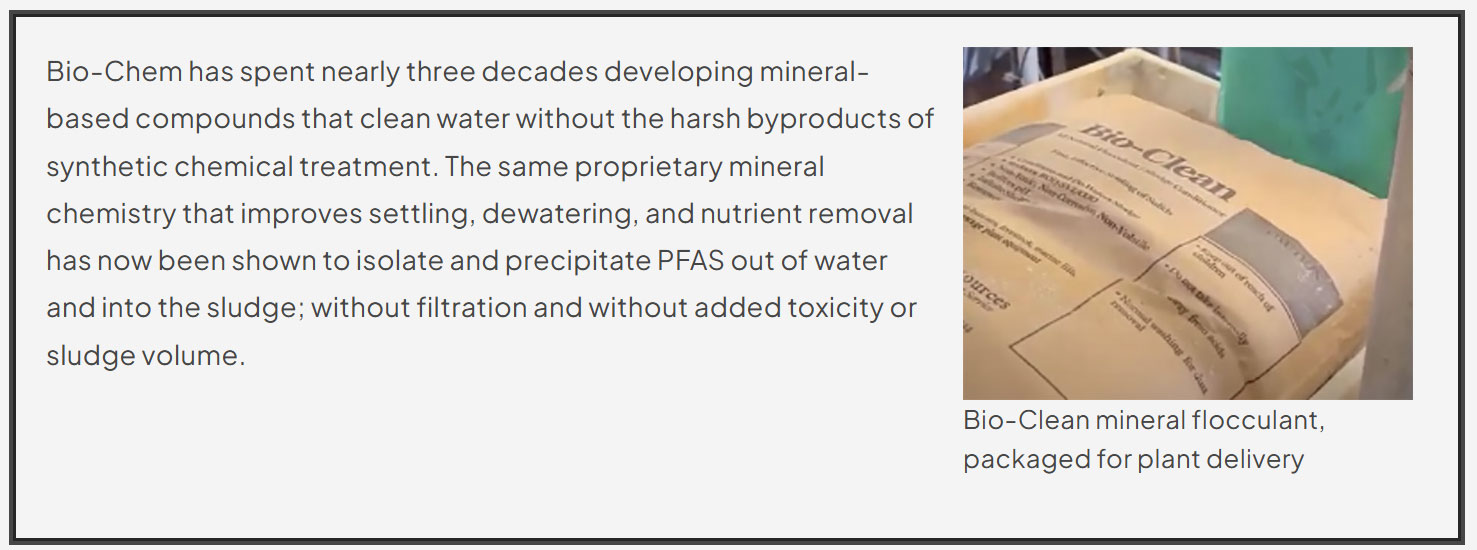
- A proprietary natural flocculant — delivers improved settling and dewatering performance compared with conventional polymer treatments.
- A rare-earth composition — originally developed for nutrient removal and now demonstrated as an effective PFAS mitigation treatment. Unlike filtration-based systems, it requires no additional infrastructure.
Track Record
Bio-Chem treatments have been in commercial use at wastewater and water treatment facilities since 1997, nearly 30 years of field application across the United States, including Wastewater Treatment Plants in:
California
Tennessee
Pennsylvania
Georgia
Kentucky
South Carolina
OHIO
Regulatory Simplicity
Adopting the Bio-Chem treatment has not required plants to amend or modify their NPDES permits. No EPA or state DEP approval has been required, and no amendment to sludge classification (Class A/B) or land-application permits has been necessary. California was the one exception: the state required initial toxicity testing before use, and treatment began once results came back satisfactory.
Why Bio-Chem
- Effective primary treatment — strong primary coagulation, superior phosphorus removal, and a wide operating pH range.
- PFAS remediation — removes PFAS from water without additional capital expenditure or new infrastructure.
- Cost effective — priced near the cost of the chemical treatment plants already use, avoiding the far higher cost of filtration-based PFAS systems and over time can replace those traditional chemicals treatments.
- Biology-safe — does not disrupt plant biology; can be used alongside existing chemical treatment or as a standalone primary treatment.
- Potential C–F bond cleavage — early evidence suggests the treatment may help break the carbon–fluorine bond within PFAS molecules in the sludge, which would reduce reliance on separate thermal destruction; this mechanism is still being characterized and is presented here as a working hypothesis, not a settled finding.
- Minimum commitment — the 60-day trial requires no plant reconfiguration, no capital expenditure for filtration, and no long-term contract.
Demonstrated Performance: Results of one of our initial Trials in 2021
(other successful trial results available)
The results below come from a wastewater treatment facility with very high PFAS levels due to landfill-leachate processing. The objective was to bring all PFAS compounds below the federal testing threshold in effect at the time, 70 ppt. Results reflect the minimum effective product dose; higher dosing further improves removal.
| PFAS Compound | Before (ppt) | After (ppt) | % Removed |
|---|---|---|---|
| PFPeA | 126.70 | 53.80 | 58% |
| PFHxA | 2,568.06 | 60.60 | 98% |
| PFHpA | 793.95 | 16.60 | 98% |
| PFOA | 2,478.90 | 49.80 | 98% |
| PFNA | 142.08 | 1.50 | 99% |
| PFDA | 107.37 | 2.06 | 98% |
| PFBS | 4,016.62 | 42.30 | 99% |
| PFPeS | 122.93 | 1.72 | 99% |
| PFHxS | 264.96 | 12.40 | 95% |
| PFOS | 240.79 | 14.70 | 94% |
| 4:2 FTS | 125.54 | 1.11 | 99% |
| 8:2 FTS | 28.11 | ND | 100% |
| PFOSA | 104.05 | ND | 100% |
| N-MeFOSAA | 109.93 | 6.78 | 58% |
| N-EtFOSAA | 123.68 | 3.49 | 58% |
Average PFAS removal across all 15 compounds was 90%. ND = non-detect.
Cost Advantage for Ratepayers
The Bio-Chem treatment is expected to cost approximately the same as the chemical treatment plants already use for dewatering and settling (e.g., standard polymers), while adding PFAS remediation, improved flocculation, and nutrient management at no additional cost. That is a substantial savings compared with layering a filtration-based PFAS system on top of conventional chemical treatment.
(Cost assumptions below are based on a standard activated-sludge system with conventional chemical treatment and average MLSS of 1,000 mg/L.)
The table and chart below summarize the five-year cost of the three conventional PFAS filtration technologies, based on the Sweeney Water Treatment case study (15 MGD average flow) and the 2023 Minnesota Pollution Control Agency (MPCA) PFAS Blueprint study, prepared by Barr Engineering and Hazen and Sawyer. Figures exclude the cost of conventional chemical treatment, which all three technologies still require.
| Filtration Technology | Capital Cost | Annual O&M | 5-Year Total |
|---|---|---|---|
| Granular Activated Carbon (GAC) | $46,000,000 | $2,900,000 | $60,500,000 |
| Ion Exchange | $46,000,000 | $2,100,000 | $56,500,000 |
| Reverse Osmosis | $150,000,000 | $4,700,000 | $173,500,000 |
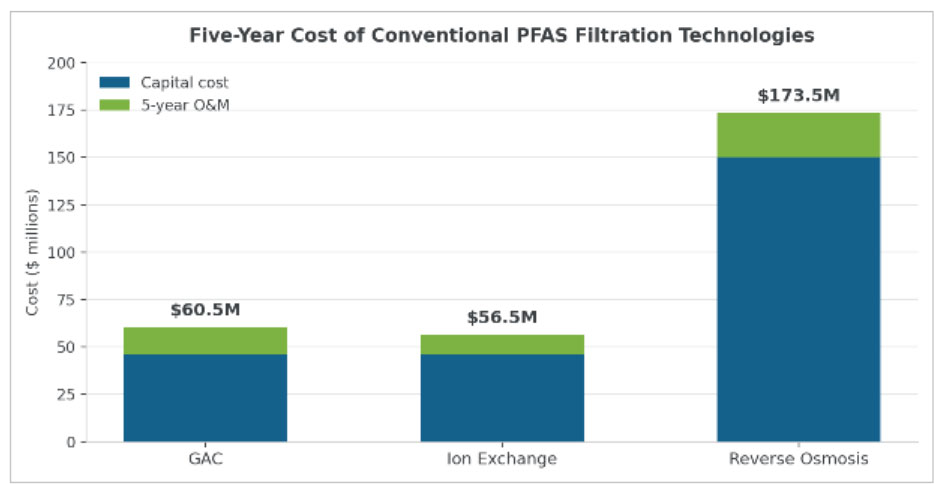
Reverse osmosis costs roughly three times more than GAC or ion exchange over five years; the Bio-Chem trial is designed to test an alternative with no comparable capital outlay.
60-Day Trial Program
A 60-day field trial is the most efficient and economical way for a WWTP, utility authority, municipality, or State DEP to evaluate the Bio-Chem treatment’s performance, implementation requirements, and potential cost savings — producing site-specific data to support a long-term PFAS management decision. The trial covers:
- Baseline Assessment. If your facility has already been tested under a state PFAS monitoring program, that data can often serve as the baseline; otherwise, an initial sampling round establishes one quickly.
- Jar Testing. Bio-Chem conducts jar tests to safely determine optimal feed rates and identify the most effective catalyst for the facility’s specific water chemistry.
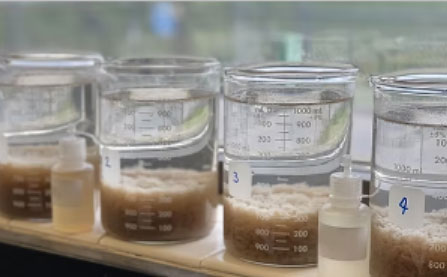
Jar testing in progress: determining optimal feed rate and catalyst for site-specific water chemistry.
3. Tailored Treatment. Once compounds and feed rates are confirmed, treatment begins as a supplement to the plant’s existing chemical regimen, with conventional chemicals phased out gradually over the 60-day period. Influent, effluent, and treated samples are tested on the same day to ensure consistent conditions.
4. Biosolids Testing. Included in every trial at no additional charge. In an earlier trial, treated biosolids reached non-detect levels (<10 ppt) with no additional processing — no heat, drying, or filtration required.
5. Summary Report. A full report detailing trial results is delivered at the conclusion of the 60-day period.
How It Works
The treatment is added continuously to the aeration basin or mixing chamber of any water or wastewater treatment plant, no alteration to existing infrastructure is required. Combining Bio-Clean with the rare-earth lanthanide solution precipitates PFAS out of the water and into the sludge, where it can be addressed without filtration or significant changes to plant operations.
Because Bio-Clean is insoluble, feed rates are determined by the molecular weight of the composition rather than conventional dosing approaches, allowing lower application rates and less inorganic biosolids than traditional chemical programs. The composition draws on alkaline earth elements, alkali metals, transition metals, and non-metal elements — including magnesium, calcium, sodium, carbon, potassium, iron, and oxygen, with chlorides, sulfite, and fluoride present in trace amounts — combined under utility patent. Some treatment plants have used it to eliminate other chemical treatments altogether.
Feed rate and catalyst selection are confirmed through jar testing before full deployment, following the same protocol used in every trial.
Watch: precipitating PFAS at a 5 MGD wastewater treatment plant in Southern California
Operational Benefits
✓ Improves settling
✓ Settles scum, filamentous bacteria, algae, grease, and foam
✓ Reduces BOD, TSS, and SVI
✓ Improves dissolved oxygen (DO)
✓ Reduces dewatering costs
✓ Stabilizes sludge blankets and reduces washouts
✓ Increases sludge density without packing
✓ Natural, safe, and efficient

Final trial pricing will depend on the designated WWTP’s flow rate and jar-testing results and will be provided before any trial is agreed to.
Get started
Boylan Crest Advisors and Bio-Chem welcome the opportunity to discuss a 60-day trial at your facility. In most cases, a trial can begin with jar testing alone, no long-term commitment and no capital improvements required to get started.
Contact us at info@boylancrest.com